Energetic Hygiene – Protection from Toxic Energies in Everyday Life
Imagine starting your morning refreshed and clear-headed. Then, after a conversation with a particular person, a long stretch in a crowded room, or hours of scrolling through the news, you suddenly feel drained, irritable, or hollow. You haven't done anything physically demanding – and yet everything feels heavier.
Welcome to the world of energetic hygiene.
This isn't an esoteric concept reserved for people who meditate with crystals and collect aura photographs. Energetic hygiene is a practical life skill – as everyday as brushing your teeth or washing your hands. Only this time, it applies to your inner energy field.
What Is Energetic Hygiene?
Physical hygiene protects your body from germs, dirt, and pathogens. Energetic hygiene protects your energy field – the complex interplay of emotions, thoughts, moods, and what many call the aura or bioelectric field – from outside influences that destabilize, exhaust, or displace you from your center.
Every person has an energy field. This isn't a mystical special status – it's an expression of being alive: your nervous system constantly responds to environment, people, and situations. Your body receives and transmits signals long before the mind processes them. Energetic hygiene means caring for this system consciously – cleansing it, strengthening it, and protecting it from overload.
A crucial distinction: energetic hygiene does not encourage a victim mentality. It's not about hiding from a hostile world or viewing other people as threats. It's about self-responsibility, cultivating inner clarity, and developing the ability to remain open and present – without losing yourself in the process.
The Science Behind It: Mirror Neurons, Emotional Contagion, and Resonance
Even though the language of energy work is traditionally spiritual, there are solid scientific foundations for the phenomena it describes.
Mirror neurons are nerve cells that activate when we observe an action or emotional expression in another person – as though we were experiencing it ourselves. This system is the neurobiological basis of empathy. It explains why we become restless in a room full of agitated people, why laughter is contagious, and why some people consistently lift us while others visibly deplete us.
Emotional contagion – a well-documented phenomenon in social psychology – describes how moods and emotions transfer between people without our conscious awareness. Research shows that even brief interactions can measurably shift the emotional state of everyone involved.
Resonance phenomena are well known from physics: oscillating systems that are close together tend to align with each other. Applied to the human energy field, this means you absorb the frequency of your environment – often unconsciously, often unwillingly.
None of this proves that "energies" exist in a metaphysical sense. But it does explain why the concepts of energetic hygiene work – on psychological, neurological, and social levels.
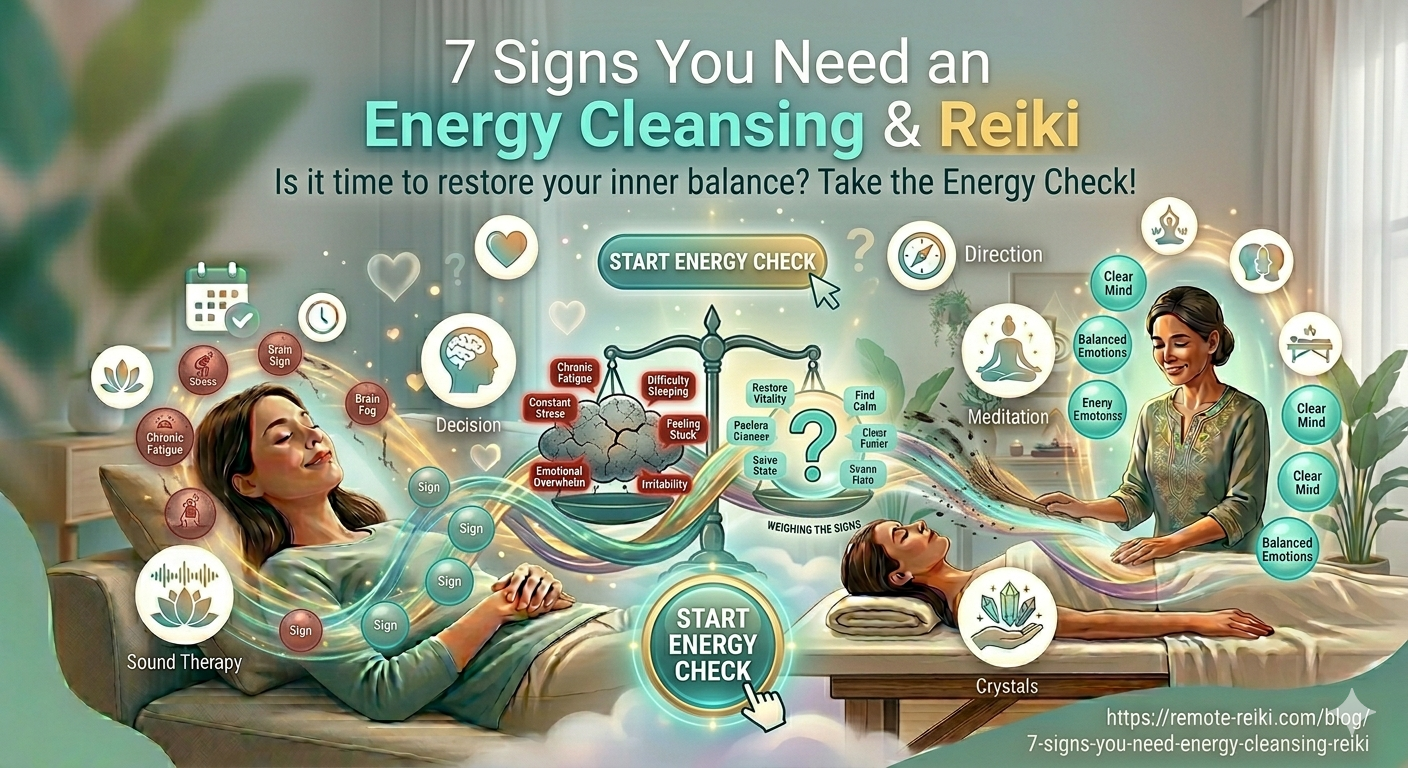
8 Warning Signs That Your Energy Field Is Compromised
- Unexplained exhaustion: You've slept enough, but after certain situations or encounters, you feel completely drained.
- Thoughts that don't feel like yours: You find yourself ruminating about problems that aren't really yours, or thinking in patterns that feel foreign.
- Emotional hangover: After an intense conversation, a party, or a conflict, you need hours to feel like yourself again.
- Inner restlessness without cause: You feel unsettled, anxious, or irritable without any concrete trigger in your own life.
- Loss of your own perspective: You're uncertain about what you actually want, feel, or think – as though your own needs have become blurry.
- Physical symptoms: Headaches, pressure in the chest, stomach tension that arise without a physical cause.
- Irritability and overreactions: Small things trigger large reactions because the system is overwhelmed.
- Feeling "not quite there": Dissociation, fogginess, or emotional numbness after intense social interaction.
None of these signals automatically indicate energetic contamination – sometimes you're simply tired or unwell. But when these patterns appear regularly after specific people, places, or situations, it's worth looking more closely.
The 5 Most Common Sources of Energetic Contamination
People: Some individuals consistently leave you feeling empty or drained after contact. This is rarely malicious – often these are people who are themselves emotionally overwhelmed and unconsciously draw energy from their surroundings. Chronically negative, dramatizing, or complaining people fall into this category, as do those who never take personal responsibility.
Places: Spaces carry histories. Hospitals, prisons, locations charged with intense emotional events, or simply crowded and noisy environments can stress your energy field. Even your own home can carry energetic residue from accumulated emotional tensions.
Media: Hours of news consumption, social media filled with comparison culture and outrage content, horror series, catastrophe videos – all of this is processed by your nervous system as though it were personally experienced. That costs energy.
Stress and overwhelm: Chronic stress weakens natural protective functions – physically and energetically. An overtaxed nervous system is more permeable to external influences.
Old patterns and unconscious beliefs: Unresolved trauma, beliefs like "I have to handle everything myself" or "My needs aren't important" make the energy field vulnerable from the inside. Energetic hygiene also means recognizing these internal leaks.
Self-Assessment: How Permeable Are Your Energetic Boundaries?
Answer the following questions honestly, without overthinking:
- Do you regularly absorb other people's moods without wanting to?
- Is it hard for you to switch off after social interactions?
- Do you often feel responsible for other people's emotions?
- Do you frequently say yes when you mean no
- out of fear of their reaction?
- Do you consistently feel worse after certain people than before?
- Do you need long recovery times after crowds or intense conversations?
- Do you have difficulty distinguishing your own feelings from those of others?
0–2 Yes: Your boundaries are relatively stable. Continue refining them.
3–4 Yes: You're averagely permeable – a hygiene practice is worth establishing.
5–7 Yes: Your boundaries need urgent attention. This is a signal, not a judgment.
People with high empathy or traumatic backgrounds tend toward greater permeability. This is not a weakness – but it does require more conscious care.
12 Practical Protection Techniques
- Grounding: Stand barefoot on earth, breathe consciously, connect with your body. Grounding prevents you from "drifting" into foreign energies.
- Light shield visualization: Imagine being enveloped in warm, golden or white light – like a membrane that protects you while still allowing genuine connection. Practice this as a 2-minute morning ritual.
- The "returning" ritual: After draining encounters, visualize giving back everything that isn't yours – without resentment, simply as a clear inner action.
- Conscious no: The most effective energetic protection tool is a clearly communicated boundary. Practice short, friendly, but unambiguous refusals.
- Digital hygiene: Introduce deliberate media times, limit news consumption, make social media detox a regular practice.
- Physical space change: After a draining situation, change your physical environment when possible. Fresh air, water, light – these signal to the nervous system: new situation.
- Cold water: Wash your hands, splash your face, or take a cold shower – water has a cleansing effect on the nervous system and physiologically interrupts stress patterns.
- Breath anchor: Three deep breaths in which you consciously exhale what doesn't belong to you. Simple, effective, applicable anywhere.
- Physical movement: Shaking, walking, dancing – movement helps the body discharge absorbed tension.
- Sage, Palo Santo, or essential oils: For those who resonate with these practices, burning herbs or using oils can function as rituals of cleansing and reorientation.
- Journaling: After intense situations, briefly write what you experienced and what you're releasing. Externalization is energetically relieving.
- Conscious connection with stabilizing people: Actively seek contact with people who uplift you. Good energy is just as contagious as draining energy.
Daily Energetic Hygiene Routine
Morning (5–10 minutes): Before you check your phone: three deep breaths. Visualize golden light flowing through your body and field. Set a clear intention: "Today, I stay in my own center." Optional: short grounding exercise, barefoot contact with the floor.
Midday (2–3 minutes): Quick "energy check-in": How am I feeling right now, and what of this is actually mine? If you feel loaded or tense: wash your hands, breathe deeply, step outside or to the window briefly.
Evening (10–15 minutes): Active "discharge" of the day: What do I consciously notice that I want to release? Warm shower with the visualization of everything foreign flowing away. Short journaling or quiet sitting. No screens directly before sleep.
Emergency Aid: What to Do After Energetically Draining Situations
There are moments – a heated conversation, a conflict, an overwhelming crowd – after which you need immediate support. Here's how to proceed:
First: Leave the situation. Physical distance isn't flight; it's self-protection.
Then: Ground and anchor your body. Wash your hands, cold water on your face, feet on the floor. The nervous system needs the signal: it's over.
Next: Process emotionally. First with yourself – brief stillness, a breathing exercise. If needed: talk to a trusted person.
Finally: Release ritual. Write down what you experienced and burn or tear it up symbolically. Or say aloud: "I give back what is not mine."
Recognizing Energy Vampires and Setting Limits – Without Victim-Blaming
The term "energy vampire" sounds dramatic but describes a real phenomenon: people after whose contact we consistently feel depleted. Importantly: most of this is unconscious. Nobody wakes up and decides to drain others today.
Typical patterns include: chronic complaining without willingness to take action, emotional manipulation ("You're the only one who understands me"), perpetual drama, inability to practice reciprocity, and the constant extraction of attention and validation.
Setting limits doesn't mean judging these people. It means structuring the relationship so that it doesn't harm you.
Concretely:
- Dose the time. Brief, focused interactions rather than long, exhausting ones.
- Be direct. "I notice I need some distance right now" is more honest than silent withdrawal.
- Stop offering solutions that aren't taken up. Compassion yes, co-dependency no.
- Recognize: if you consistently feel worse after a relationship than before, that's important information
- not a moral verdict on the other person.
Acknowledging your own permeability is strength, not weakness. And: sometimes we are the difficult energy for others.
The Role of Space: Energetic Room Cleansing
Spaces store energetic patterns. This sounds mystical – but everyone knows the experience of entering a room and immediately sensing whether the atmosphere is pleasant or oppressive. That's not imagination.
Emotional resonance leaves physical traces in spaces: altered air composition, sound levels, subtle sensory signals that the nervous system picks up.
Room cleansing practices address this layer:
Ventilating and light: Fresh air and daylight are the simplest and most effective means. Open windows after charged moments – after conflicts, periods of grief, after intense work.
Smoke cleansing: Sage, incense, Palo Santo, or cedar – burning herbs has served a cleansing function across cultures for thousands of years. Scientifically, there's evidence that certain smoke actually reduces airborne microbes.
Sound: Singing bowls, tuning forks, or simply loud clapping in corners (where stagnation is said to gather, according to energetic tradition) can loosen the atmosphere of a room.
Salt: Placing small bowls of coarse sea salt in corners and discarding them after a few days is a simple household ritual.
Plants and water: Living plants and flowing water (indoor fountains) measurably improve atmosphere – through humidity, ionization, and psychological wellbeing.
How Remote Reiki Works Preventively and Strengthens Your Energy Field
Reiki is a Japanese energy work method in which life energy is intentionally directed to support healing and balance. Remote Reiki functions without physical presence – the transmission occurs through intention and connection beyond spatial limits.
From an energetic perspective, Remote Reiki works preventively by cleansing the energy field, dissolving blocked flows, and strengthening the field's capacity to self-regulate. It's comparable to an immune system boost: applied not when the crisis has already arrived, but as regular strengthening.
In practice, regular Reiki sessions (including remote) can help soften old, hardened energy patterns, calm the nervous system, strengthen connection to your own body and energy field, and build inner resilience that makes external influences less sticky.
Remote Reiki isn't a substitute for psychological work or medical treatment – but it is a powerful complement within the overall framework of energetic health.
14-Day Energetic Hygiene Challenge
This practical framework gives you a structured entry point. Each day requires 5–15 minutes.
Day 1–2: Sharpen awareness. Keep an energy journal: after every social interaction, note how you felt before and after.
Day 3–4: Introduce grounding. Stand barefoot on earth for 5 minutes daily, or practice deep breathing exercises in the morning.
Day 5–6: Digital hygiene. Reduce news and social media to a maximum of 30 minutes daily. Note the change.
Day 7: Midpoint check-in. What have you noticed? Which energy sources have depleted you, which have built you up?
Day 8–9: Practice boundaries. On two days, consciously say no once each day and observe the reaction in yourself – not the other person's reaction.
Day 10–11: Space work. Consciously ventilate, burn herbs, or cleanse your main living space. How does the room feel afterward?
Day 12–13: Establish a protection ritual. Choose one protection technique from the list above and practice it morning and evening.
Day 14: Reflection and integration. Write one page: What has changed? What are you taking with you? Which practices will you integrate permanently?
After these 14 days, you'll have a personal toolkit – not a perfect system, but a living, practical foundation.
Energetic hygiene isn't a one-time event – it's a daily practice. Like physical hygiene, it doesn't require perfection. It requires continuity. The more clearly you understand what touches, influences, or burdens your field, the more freely you can choose what you allow in and what you don't.
This isn't a retreat from life. It's the prerequisite for being truly present within it.