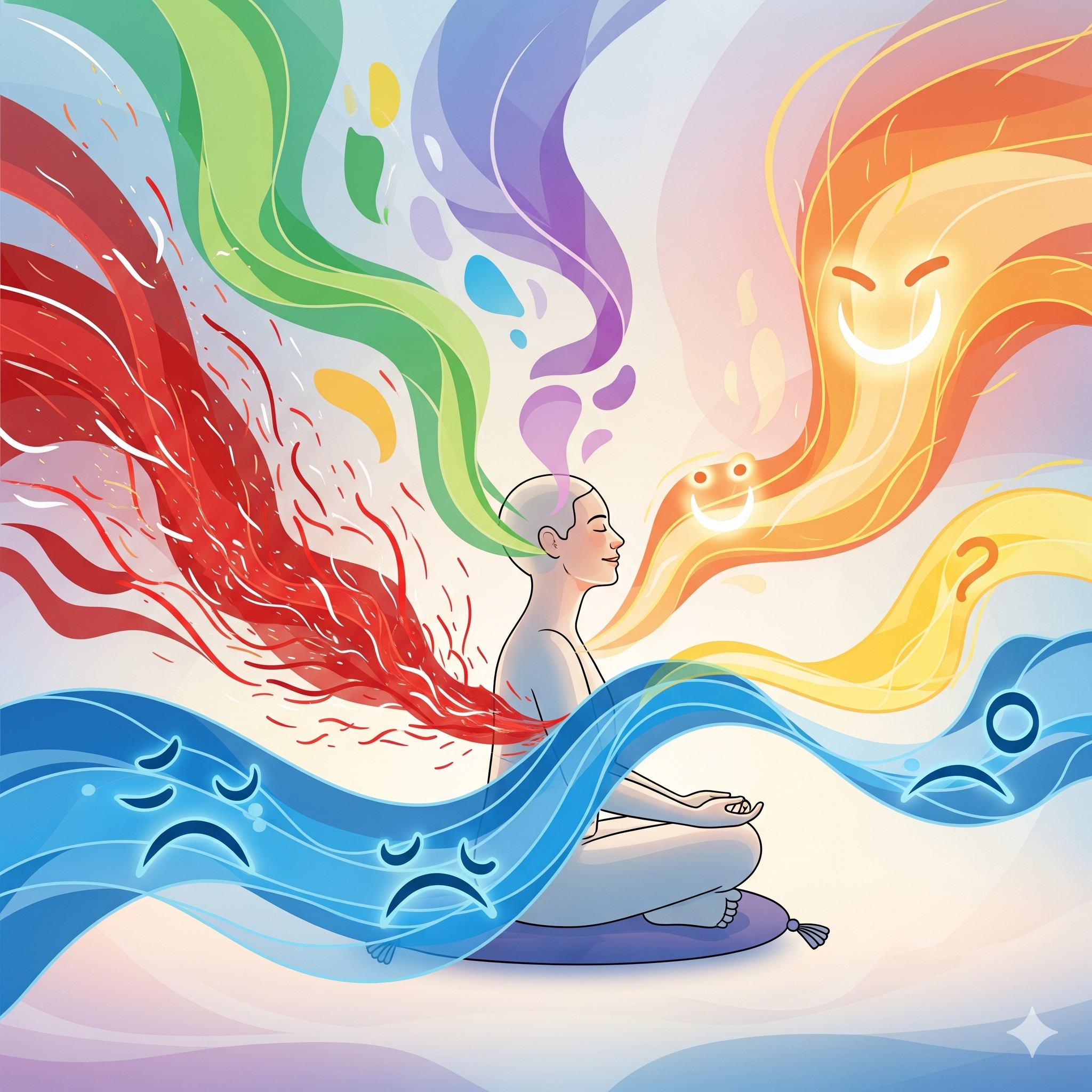
You know that moment: a wave of sadness, anger, or fear rises within you – and immediately comes the second impulse to push it away. Be strong. Pull yourself together. It's really not that bad. What if that very reaction is the real problem?
The Cultural Lie: "Negative" Emotions Are Flaws
We grow up in a culture that divides emotions into two camps: the good ones – joy, gratitude, enthusiasm – and the bad ones – anger, sadness, fear, shame. The latter are treated as signs of weakness, immaturity, or lack of control. In families, they are often ignored or punished. At school, there's no class on how to understand them. At work, they are simply unwelcome.
This division is deeply ingrained in us. And it's wrong.
Emotions have no moral value. No feeling is inherently good or bad, right or wrong. What differs is how pleasant or unpleasant they feel – and what we do with them. A feeling we label "negative" is not a sign that something is wrong with us. It's a sign that something in our life deserves attention.
Real emotional immaturity doesn't lie in feeling sadness or experiencing anger. It lies in being overwhelmed by these states – or suppressing them so rigidly that they control us from within.
What Emotions Actually Are: The Neuroscience
Lisa Feldman Barrett, neuroscientist at Northeastern University, has developed a thesis through decades of research that fundamentally changes our understanding of emotions: emotions are not universal, hard-wired reactions that "happen" to us. They are predictions – active constructions of the brain based on past experiences.
Your brain constantly works to interpret signals from your body: heart rate, muscle tension, depth of breath, hormone release. These body signals carry no inherent meaning. The brain assigns meaning to them – and calls the result an emotion.
What does this mean for us? Emotions are not objective truths about the world. They are interpretations. And interpretations can change – with more knowledge, with experience, with conscious practice. This doesn't diminish feelings. It reveals their potential.
Emotions are also physical events. Sadness is not just a thought – it's heaviness in the chest, slow breathing, exhaustion in the limbs. Fear is not just worry – it's an accelerated heartbeat, tense shoulders, a shallow breathing pattern. Anyone who ignores this physical dimension misses the most important part of the message.
The Language of Feelings: Decoding Each Emotion as a Message
If emotions are information, what information do they carry? Here is an orientation – not a rulebook, but an invitation for self-observation:
Fear
Fear signals perceived danger – real or imagined, physical or social. It says: "There's something here that threatens or overwhelms me." Its message is: Look carefully. Is the threat real? What resources do you need? Sometimes fear also signals growth: what we fear most is often what matters most.
Anger
Anger arises when something important is violated – a boundary, a value, a need for respect. It is energy. Its message: "A boundary has been crossed. Something needs to change." Not acted out destructively, but understood, anger can be the most powerful engine for change.
Sadness
Sadness is the response to loss – of people, situations, dreams, a version of ourselves. It is not pathology but a natural integration process. Its message: "Something was meaningful. Allow yourself time to grieve before moving on."
Shame
Shame is perhaps the most misunderstood feeling. It differs from guilt: while guilt says "I did something bad," shame whispers "I am bad." It often arises early in life through rejection or humiliation. Its buried message: "I long for belonging and dignity."
Loneliness
Loneliness is not the same as being alone. It is the signal of an unfulfilled need for genuine connection. Its message is clear: "I need real contact – with myself or with others."
Guilt
Guilt arises when our actions don't align with our values. It invites us to take responsibility and repair what is repairable. The difference from shame is crucial: guilt is action-oriented, shame is identity-oriented.
Why Suppressing Emotions Makes Us Sick
The research is clear: suppressing emotions is not the same as processing them. Studies show that chronic emotional suppression is associated with elevated cortisol levels, weakened immune function, sleep disturbances, and increased risk of depression and anxiety disorders.
But it's not only about physical health. When we push away our uncomfortable emotions, we push away the information they carry with them. The result: we repeat patterns, don't understand our own reactions, can't truly show ourselves in relationships.
There is another paradox: suppressed emotions don't disappear – they return, often amplified, often at an inconvenient moment. The feeling we breathed away in the morning is sitting at the dinner table in the evening. What we repress governs us – just without our knowledge.
The Difference: Feeling vs. Acting From Emotions
Here lies a central misunderstanding. Treating emotions as information does not mean following them blindly. It means perceiving them and then consciously choosing how to act.
The spectrum looks like this: At one end stands suppression – the feeling is fought away, ignored, numbed. At the other end stands reactivity – the feeling directly determines behavior: anger explodes, fear paralyzes, sadness retreats to bed.
The healthy middle ground is conscious feeling: you perceive the emotion, give it space, understand its message – and then choose how to act. That is emotional intelligence: not the absence of feelings, but the ability to engage in dialogue with them.
Self-Test: How Do You Handle Uncomfortable Feelings?
Observe yourself honestly over the next few days. Which of these patterns do you recognize in yourself?
- You quickly change the subject when a conversation becomes emotional.
- You suddenly become very busy when an uncomfortable feeling arises.
- You rationalize: "Things could be much worse" or "It's really not that important."
- You reach for distraction: scrolling, eating, TV shows, alcohol.
- You often aren't sure what you're actually feeling.
- You feel ashamed of some of your emotions.
- You are sometimes overwhelmed by emotions and don't know how to get out.
No point here is a judgment. Each of these patterns is understandable – often even a clever survival strategy from a time when direct contact with feelings was too painful or too unsafe. The question is: does this pattern still serve you today?
7 Techniques for Healthy Emotion Regulation
1. The RAIN Method
RAIN is a four-step tool from mindfulness practice that helps you stay in contact with difficult emotions without being overwhelmed by them:
- Recognize: Notice what is present. "I feel anxiety."
- Allow: Let the feeling be there without pushing it away or amplifying it.
- Investigate: Where do you feel it in your body? What does this feeling need?
- Nurture: Respond to yourself with the care you would show a good friend.
RAIN is not a quick fix – it is a practice of presence.
2. Naming – Labeling Feelings
Neuroscientific research shows that when we give a feeling a name, activity in the amygdala – the brain's emotional alarm system – decreases. Simply saying "I feel fear" changes the neurobiological response.
The more precise, the better: not just "sad" or "stressed," but "exhausted despondency," "nervous anticipation," "quiet sorrow." Building an emotional vocabulary is a direct investment in your emotional health.
3. Body Anchoring
Emotions are physical events. Instead of diving directly into thoughts about the emotion, direct your attention first to the body: Where do you feel the emotion? What does the sensation feel like – tight, warm, heavy, trembling? Breathe into that area. You don't need to solve anything – just notice.
4. Journaling
Writing down feelings creates distance without suppression. It activates the prefrontal cortex – the thinking and regulation center – and helps to recognize patterns in one's own emotional responses. Three starter questions: What am I feeling right now? What might be triggering this feeling? What do I need?
5. Movement
Emotions are physical energy. Sometimes they don't need intellectual engagement – they simply need physical expression: walking, running, dancing, shaking. Movement helps process emotional energy and brings the nervous system back from an activated state.
6. Co-Regulation
Humans are social beings – our nervous systems regulate themselves in connection with others. The feeling of being heard and seen is neurobiologically effective. Sometimes the most valuable thing you can do for a difficult emotion is call a trusted person and say: "I need someone to listen to me right now."
7. Creative Expression
Some emotions can't be put into words. They seek other pathways: music, painting, writing, singing, cooking, pottery. Creative practice is not an escape from the emotion – it is a different channel for the same expression. Whatever gives you a sense of flow can be a way to set emotional energy in motion.
Emotions in Daily Life: How to Name Feelings Without Being Overwhelmed
The practice starts small. You don't need to dive deeply into your emotional world in every situation. But you can begin to develop a kind of inner commentary system: "Ah, there's impatience." "That feels like disappointment." "I notice tension."
These formulations have a crucial quality: they give the feeling space without you merging with it. "I am angry" fuses you with the emotion. "I notice anger" creates observer distance. This small linguistic step has a powerful effect.
One more thing: emotional maturity doesn't mean always knowing what you feel. Sometimes the most honest answer is: "I don't know what I'm feeling right now – but there's something here." That is not failure. That is the beginning.
Relationship Context: Emotional Regulation in Conflicts
Conflicts are the hardest test for emotional intelligence – because exactly when we need to be most regulated, our nervous system switches into survival mode.
A crucial insight: you cannot think rationally in an activated nervous system. The prefrontal cortex – the part that enables perspective-taking, empathy, and problem-solving – is literally offline in an alarm state. That explains a lot.
What helps: First, recognize when you are activated. Signs include: racing heart, heat in the face, tightness in the chest, the urge to flee or fight. Second: take a pause. Not as avoidance, but as a conscious regulation strategy. "I need ten minutes to sort myself out before we continue talking" is a sign of maturity, not weakness. Third: communicate your own feelings instead of making accusations. "I feel overlooked" opens a conversation. "You always overlook me" closes it.
How Remote Reiki Resolves Emotional Blockages and Supports Processing
Sometimes an emotion gets stuck – not because we don't want to understand it, but because it's deeply inscribed in the body. Experiences that came too early, too suddenly, or too intensely can manifest as physical tension patterns that are difficult to access intellectually.
This is where Remote Reiki comes in. As energetic work, Reiki doesn't operate on the level of analysis, but on the level of bodily sensation. Many people report a deep feeling of release after a Reiki session – of feelings that were finally allowed to show themselves without being overwhelming.
This is not a contradiction to psychology – it's a complement. While cognitive approaches address the mind, energetic work can open spaces that go beyond language. Remote Reiki works independently of location: you receive the energy in your own safe space, at a time of your choosing.
If you feel that certain emotions are stuck or keep returning, Remote Reiki can be a gentle, supportive access point – not as a substitute for professional psychological guidance, but as a valuable complement on the path to yourself.
10-Day Emotion Journal Challenge
This structured challenge invites you to spend five to ten minutes each day in contact with your emotions for ten days. There are no right or wrong answers – only honest ones.
Day 1 – Taking Stock
Which emotion do I encounter most frequently today? Where do I feel it in my body?
Day 2 – The Origin Question
When did I first fight away what I was feeling today? What triggered it?
Day 3 – The Body Language of Feelings
Take a current emotion and describe it purely physically: Where is it? What color would it have? What texture? What temperature?
Day 4 – The Message
If your strongest feeling today could speak – what would it say? What does it need?
Day 5 – Old Patterns
When and from whom did you learn to hide certain feelings? What were you taught back then?
Day 6 – RAIN Practice
Apply the RAIN method to a feeling that arose today. Write through each step.
Day 7 – Feelings Without Judgment
Write a list of all the emotions you felt today – without judging them. How many were there?
Day 8 – Creative Encounter
Draw, write, or paint an emotion you experienced today – without words, just form and color.
Day 9 – Relationship Feelings
What feelings does a particular person or situation regularly trigger in you? What might this tell you about an unmet need?
Day 10 – Gratitude to the Feelings
Write a letter to a feeling you often experience as difficult. Thank it for its message. What do you want to do differently with this knowledge?
Emotional maturity is not a state you reach – it is a practice you choose daily. It doesn't begin with understanding your feelings. It begins with listening to them.